Interactive research concept
Trustworthy Semantic Communication
Trustworthy and secure AI-native 6G edge intelligence.
This separate industrial fault-detection pilot asks the same question as the loader story: when a short AI message is uncertain, can requesting more evidence improve a decision? It uses synthetic sensor observations, not vehicle cameras. Its results do not validate loader perception or remote driving.
Send the meaning that matters. Explore whether targeted evidence requests can support dependable edge AI recommendations.
Explore the simulation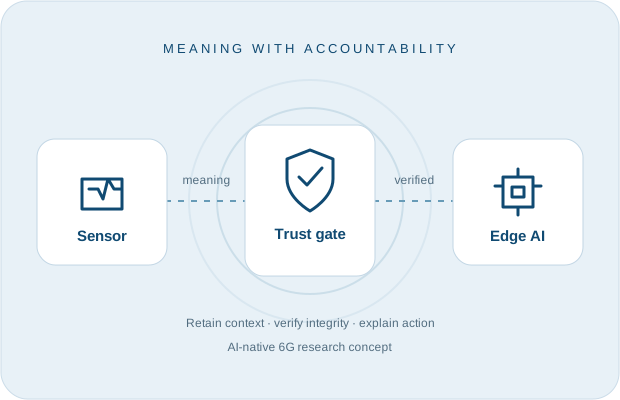
Original implementation · pilot v0.2
Inspect the research results
Three seeds and 1,800 distinct test machines produced 214,200 policy-condition evaluations. These results come from a trained NumPy classifier and a packet-level simulator. They do not establish a new research contribution or real 6G performance.
Mixed results. The policy needs revision.
The source-exclusion approximation improves the configured decision loss in some attack cases, but performs worse on benign observations and fails to acquire evidence in the schema-mismatch case. Different coverage and communication costs prevent a claim of consistent superiority.
| Policy | Coverage | Error among accepted | Critical miss rate | Mean bytes | Simulated delay |
|---|
Coverage means how often the system gives an answer in time. Error among accepted means how often those answers are wrong. Critical miss rate counts serious faults missed, including when no answer is given. Mean bytes measures data sent; simulated delay measures time until a decision. Coverage counts timely recommendations across all episodes. Error among accepted excludes abstentions; critical misses include them. Zero accepts makes selective error undefined. Each row aggregates three seeds; thresholds were tuned on separate validation data. These operating points are not matched for coverage.
Replay a saved episode
The first test machine from seed 17, shown consistently across conditions and policies. Ground truth is used only for evaluation. Changing a selection loads saved simulator outcomes; it does not train or run an AI model in your browser.
What this pilot tests
Authentication and truth
Messages use source-specific HMAC authentication. A false observation from a compromised sensor can still authenticate correctly. HMAC does not encrypt the data.
Evidence acquisition
Seven policies choose whether to request temperature history, a fresh reading, peer temperature, vibration, or context. The proposed approximation excludes each sensing source when estimating risk.
Accountable evaluation
The simulator counts request and response bytes, retries, delays, and failures. Twelve invariant tests passed, and an independent full rerun produced identical outcome fingerprints.
Read the pilot limitations
The source-exclusion approximation is not the planned conditional compromise estimator and is not a calibrated security bound. The full-feature reference sends summaries, not raw sensor histories. Acquisition uses approximate costs; logged costs use actual encoded bytes. Correlated sensor errors, an easy synthetic generator, and fixed processing times limit interpretation. No physical network, privacy guarantee, or machinery control is evaluated.
Next: model compromise conditionally, test complementary evidence with two-step acquisition, and compare at matched coverage on new test machines.