TRUST6G Interactive research demo
Drive a loader.
From far away.
What should a remote operator trust? Compare camera pictures with AI summaries—and see how missing information changes a decision.
Simulated timber yard · no equipment connected
Choose your experience

Research supported by VINNOVA
TRUST6G: Trustworthy and Secure AI-Native 6G Edge Intelligence.
Project reference 2026-01733 · Coordinated by Mid Sweden University.
1 / 7Meet the operator
How do you drive a machine from far away?
The loader sends a camera view to a control center. The operator needs a recent view before deciding whether to move or stop.
Ready · 90 seconds
Three modeled situations in the same timber yard. Camera scenes, AI messages and network timings are simulated.
THE REMOTE TIMBER YARDIllustrative experience
1 · CAMERA SEESThe yardWhat is happening now
2 · INFORMATION TRAVELSA pictureTo the control center
3 · CONTROL CENTER DECIDESWaiting for a viewOnly the information that arrived
4 · LOADER REPLIESWaiting for confirmationSending a command is not confirmation
The AI message missed the person. A correct sender does not guarantee correct information.
WHAT IS HAPPENING NOWThe yard is clear
Operator view · last received state
Use the camera controls, or Alt + dragIllustrative remote-operation model
Follow the story with the controls below. 3D is unavailable here.
Timber loaderCamera · depth · motion
WORKER IN THE LANE
Meaning + checksWhat matters for driving?
Control centerRemote operator
Yard cameraA fresh perspective
LOADER MESSAGE“Person near path?”
FRESH OBSERVATION“Person confirmed.”
Return commandControl travels back
Sensing the yard
Warning Checked message Second observation
01 / REALITY
The yard keeps changing.
The operator’s view depends on what arrives over the connection. Compare the person and loader on both sides.
- Reach the loading point
- Check behind and around the loader
- Lift and wait for confirmation
What happened?
The second camera can reveal the worker; later messages from the original AI may still miss them. Sending less data helps only when important details survive. This omission is an authored example.
GPS · noisy position—
IMU · estimated motion—
LiDAR · sent returns—
Camera · rule detection—
No fusion estimate received.
Simulated measurements. Blue dots are received scan features; the ring shows position uncertainty. Wire outlines are the preloaded yard layout.How is the operator’s 3D view built?
SIMULATED SENSOR PIPELINE · NO REAL HARDWARE
- GPSWhere am I?
- IMUHow am I moving?
- LiDARWhat shape is nearby?
- CamerasWhat is in view?
- Map databaseWhat layout is known?
ON THE LOADERFusion + local mappingKalman position estimate with known LiDAR landmarks
Scan-based local map2D scan points registered by estimated pose, displayed in 3D
Select what mattersPosition, obstacles, uncertainty and capture time
Communication linkInformation can arrive late, be lost or be wrong
Operator’s 3D displayKnown layout + received information, with age and confirmation
This demo now simulates GPS, IMU, LiDAR and camera detections, fuses position, and accumulates a local scan map. It uses known landmark associations and a preloaded layout. It does not implement full SLAM, loop closure, sensor calibration or learned vision. Sensor-feature payload sizes are still illustrative assumptions.
Your turn
The AI missed the person. What information or action would you request?
Choose an action, then advance to see what arrives. These controls affect only this illustration.Observe the yard4 s · person enters16 s · compare outcomes
The demonstration · what happened
Useful information. A response you can check.
These describe one modeled example. They do not establish that a vehicle or AI system is safe.
Why should we care?
Remote work needs dependable decisions.
Forestry operators, remote-site workers and control centers could benefit from timely information when connectivity is limited. The research asks whether selected facts can reduce communication demand while preserving the information needed for a decision.
What a real pilot must prove
Test real cameras and sensors, missed workers and false alarms, end-to-end delay, lost commands and replies, operator understanding, and independent local stopping. Compare camera and AI approaches on the same recorded situations. This teaching model supplies none of that validation.
Future 6G could support nearby AI processing and timely communication; those benefits would need measurement. These ideas can also be studied on existing networks. This demo does not demonstrate a working 6G network or validated vehicle safety.
Check your understanding · three questions
Three quick questions
Try an answer to see the explanation. Your answers stay on this page and are not saved or sent.
1. Why send an AI task message?
2. Can a message from the expected sender still be wrong?
3. How do you know the loader applied STOP?
The idea to remember: send what matters, check what may be missing, and confirm what the machine did.
TAKE THE CONTROLS
Can you collect the timber with the information you receive?
Drive to the loading point, check the whole area, then lift. Commands travel to the loader; a reply confirms what happened.
One loader and one yard. Switching views pauses at the same moment; each view shows only what arrived.
Prepared trial JSON
Your browser may save a JSON file. If downloads are unavailable, select and copy the complete trial below. It includes all three modes, assumptions, snapshots, and events.
Same world · same network · three modes
What changed in this run?
Totals below cover the full 16-second run. They are computed from the model, not real video codecs or a 6G network. Less data does not guarantee a better decision.
Messages, checks, and acknowledgements
Model assumptions and reproducible evidence
This original teaching model uses rule-based sensing and assumed encoded frame sizes: full video 20,000 bytes, compressed video 2,500 bytes, and semantic messages 240 bytes. Video is sampled every half second. Semantic messages update on a state change plus a one-second heartbeat. All modes share the same automatic control rule.
A slow link has 8,000 bytes per second per direction and 0.7 seconds of propagation. The clear link has 64,000 bytes per second and 0.12 seconds. Observations expire after 1.2 seconds. Commands expire locally after one second. Integrity and replay checks are modeled flags and sequence rules, not real cryptographic authentication.
Compressed sensing can miss a distant person. The misleading-detector event suppresses semantic object extraction while video retains visual context. These are declared scenario assumptions—not measured detection accuracy. An operator video thumbnail is a rendering of the sampled simulation state, not an encoded or decoded video stream.
Saved evaluation: 720 mode evaluations across 240 reused world/network configurations and ten seeds. Deterministic conditions repeat across seeds. They are not independent real vehicle trials.
Completion means reaching the task goal (and finishing the lift for pickup) without crossing the model's near-contact threshold during lane occupancy. Movement while the lane is occupied is reported separately. Neither metric establishes safety. Manual interventions re-run all modes at the same intervention time.
What does “semantic” mean in this demo?
Send the meaning needed for the next decision.
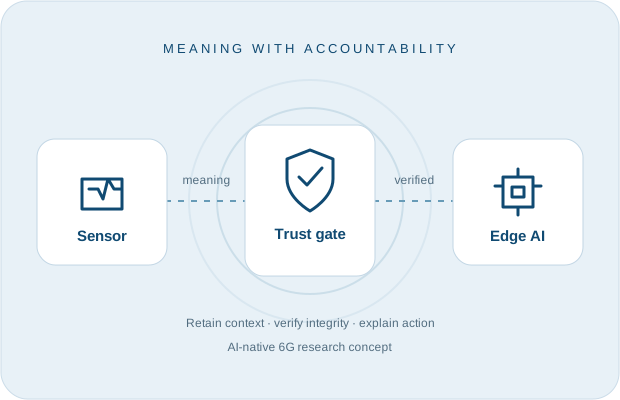
A remote machine produces video and other sensor information. Sending everything can overwhelm a limited connection. AI can turn that information into a task message, such as “A person is crossing ahead.” Sharing this task-relevant meaning is called semantic communication.
Neither approach always wins. The useful information depends on the task, the connection, and what the AI understood.